


-yellow.svg)

The package bayesRecon implements several methods for
probabilistic reconciliation of hierarchical time series forecasts.
The reconciliation functions are:
reconc_gaussian: reconciliation via conditioning of
multivariate Gaussian base forecasts; this is done analytically;reconc_t: reconciliation via conditioning of Gaussian
forecasts with uncertain covariance matrix; the reconciled forecasts are
multivariate Student-t; this is done analytically;reconc_BUIS: reconciliation via conditioning of any
probabilistic forecast via bottom-up importance sampling; an alternative
method for discrete forecasts is implemented in
reconc_MCMC, but we recommend using
reconc_BUIS;reconc_MixCond and reconc_TDcond:
reconciliation of mixed hierarchies, where the upper forecasts are
multivariate Gaussian and the bottom forecasts are discrete
distributions; reconc_MixCond implements conditioning via
importance sampling, while reconc_TDcond implements
top-down conditioning.:boom: [2026-03-05] bayesRecon v1.0: major update to the API, added
reconc_t.
:boom: [2024-05-29] Added reconc_MixCond and
reconc_TDcond and the vignette “Reconciliation of M5
hierarchy with mixed-type forecasts”.
:boom: [2023-12-19] Added the vignette “Properties of the reconciled distribution via conditioning”.
:boom: [2023-08-23] Added the vignette “Probabilistic Reconciliation
via Conditioning with bayesRecon”. Added the
schaferStrimmer_cov function.
:boom: [2023-05-26] bayesRecon v0.1.0 is released!
You can install the stable version on R CRAN
install.packages("bayesRecon", dependencies = TRUE)You can also install the development version from Github
# install.packages("devtools")
devtools::install_github("IDSIA/bayesRecon", build_vignettes = TRUE, dependencies = TRUE)The package bayesRecon implements functions for
probabilistic forecast reconciliation. In the following examples, we
show how to use the main reconciliation functions of the package for
different types of base forecasts.
In each example, we
bayesRecon package.
Let us consider a hierarchy with 4 bottom time series and 3 upper time series, as shown in the figure above. The hierarchy is specified by the aggregation matrix A:
A <- matrix(c(
  1, 1, 1, 1,
  1, 1, 0, 0,
  0, 0, 1, 1
), nrow = 3, byrow = TRUE)
In this example, we assume that the base forecasts are multivariate Gaussian, which is a common choice for real-valued time series.
To generate the hierarchical time series, we first randomly simulate the bottom series using an AR(1) process and then aggregate them using A to obtain the upper series.
set.seed(1234)

# Simulate bottom series from AR(1) processes
n_obs <- 12  # length of the time series
B_ts <- matrix(nrow = 4, ncol = n_obs)
for (j in 1:4) {
  B_ts[j, ] <- arima.sim(model = list(ar = 0.8), n = n_obs, sd = 0.5)
}
# Aggregate to obtain upper series
U_ts <- A %*% B_ts
# Convert to mts
B_ts <- ts(t(B_ts))
U_ts <- ts(t(U_ts))
Y_ts <- cbind(U_ts, B_ts)
We compute the base forecasts using an ETS model with Gaussian
predictive distribution, implemented in the forecast
package. For simplicity, we only compute one-step-ahead forecasts, but
the same procedure can be applied to multi-step-ahead forecasts.
We also save the in-sample residuals of the fitted models, as we later need them to estimate the covariance matrix of the base forecasts.
library(forecast)

base_fc_mean <- c()
residuals <- matrix(nrow = n_obs, ncol = ncol(Y_ts))
for (j in 1:ncol(Y_ts)) {
  fit <- forecast::ets(Y_ts[,j], additive.only = TRUE)  # fit ets on each time series
  base_fc_mean[j] <- as.numeric(forecast::forecast(fit, h = 1)$mean)
  residuals[,j] <- fit$residuals
}
We then analytically compute the reconciled forecasts via
conditioning using the reconc_gaussian and the
reconc_t functions. The reconciled forecasts produced by
reconc_gaussian are multivariate Gaussian, and they are
equivalent to MinT reconciliation (Zambon et
al. 2024). The reconc_t method adopts a Bayesian
approach to account for the uncertainty of the covariance matrix of the
base forecasts; the reconciled forecasts, which are multivariate
Student-t, are typically better calibrated (see Carrara et al. 2025 for
details).
library(bayesRecon)

# Reconcile with both methods
rec_g <- reconc_gaussian(
  A,
  base_fc_mean,
  residuals = residuals,
  return_upper = TRUE
)
rec_t <- reconc_t(
  A,
  base_fc_mean,
  y_train = Y_ts,
  residuals = residuals,
  return_upper = TRUE
)

# Compare means of the base and reconciled forecasts
means <- rbind(c(base_fc_mean),
               c(rec_g$upper_rec_mean, rec_g$bottom_rec_mean),
               c(rec_t$upper_rec_mean, rec_t$bottom_rec_mean))
rownames(means) <- c("base", "reconc_gaussian", "reconc_t")
colnames(means) <- c("T", "A", "B", "AA", "AB", "BA", "BB")
print(round(means, 2))
#>                     T     A     B    AA    AB    BA    BB
#> base            -2.64 -2.24 -0.35 -2.06 -0.18 -0.19 -0.47
#> reconc_gaussian -2.73 -2.25 -0.49 -2.05 -0.20 -0.14 -0.35
#> reconc_t        -2.87 -2.37 -0.50 -2.02 -0.35 -0.11 -0.39
Finally, we compare the reconciled forecast distributions for the top series T obtained with the two methods by plotting their marginal densities.
We consider the same hierarchy of Example 1; however, we assume that the base forecasts are Poisson distributions, which is a common choice for count time series.
We randomly generate the bottom series using Poisson distributions with time-varying rates that include a monthly seasonal pattern; we then aggregate them using A to obtain the upper series.
set.seed(123)
n_obs <- 60

# Bottom time series are obtained by drawing from Poisson distributions with time-varying rates
lambda_bls <- c(3, 4, 5, 6)  # baseline Poisson rates for bottom series
seas <- 1.5*sin(2*pi*(1:n_obs)/12)  # specify monthly seasonality (period = 12)
lambdas <- outer(lambda_bls, seas, FUN = "+")  # adds seasonality to each baseline (4 x n_obs matrix)
lambdas <- lambdas + matrix(rnorm(4 * n_obs, sd = 0.1), nrow = 4) # add small Gaussian noise to rates

# Simulate bottom-level count time series
B_ts <- matrix(rpois(4 * n_obs, lambdas), nrow = 4)
# Aggregate to obtain upper series
U_ts <- A %*% B_ts
# Convert to mts
B_ts <- ts(t(B_ts), frequency = 12)
U_ts <- ts(t(U_ts), frequency = 12)
Y_ts <- cbind(U_ts, B_ts)
We compute the one-step-ahead base forecasts using the
package glarma,
which is specific for count time series. We forecast using a
glarma model with Poisson predictive distribution.
library(glarma)

base_fc <- list()
for (j in 1:ncol(Y_ts)) {
  yj <- Y_ts[,j]  # time series j
  X <- matrix(c(rep(1, length(yj)), seas), ncol = 2)  # matrix of exogenous regressors
  X_new <- matrix(c(1, 1.5*sin(2*pi*(n_obs + 1)/12)), ncol = 2)  # regressors for the forecast period
  fit <- glarma::glarma(yj, X, type = "Poi")  # fit the model
  # Compute base forecasts, which are Poisson distributions specified by the rate parameter
  fc_lambda <- glarma::forecast(fit, newdata = X_new, n.ahead = 1)$mu
  # Save the base forecast parameters in a list of lists, one for each series
  base_fc[[j]] <- list(lambda = fc_lambda)
}
We then compute the reconciled forecasts using the bottom-up
importance sampling (BUIS) algorithm (see Zambon et al. 2024
for details). The output of reconc_BUIS is a joint sample
from the reconciled distribution, which can be used to compute any
desired summary (e.g. mean, quantiles, etc.).
rec_buis <- reconc_BUIS(
  A,
  base_fc,
  in_type = "params",
  distr = "poisson",
  num_samples = 20000
)
samples_buis <- rbind(rec_buis$upper_rec_samples,
                      rec_buis$bottom_rec_samples)
rownames(samples_buis) <- c("T", "A", "B", "AA", "AB", "BA", "BB")

# Compute reconciled means
print(round(rowMeans(samples_buis), 2))
#>     T     A     B    AA    AB    BA    BB
#> 20.69  8.36 12.33  4.05  4.31  5.83  6.50

# Compute upper quantiles of the reconciled forecast distributions:
print(apply(samples_buis, 1, quantile, probs = c(0.80, 0.95)))
#>      T  A  B AA AB BA BB
#> 80% 23 10 14  5  6  8  8
#> 95% 26 12 16  7  7  9 10
Finally, we compare the base and reconciled forecasts for the top series T by plotting the base and reconciled forecast distributions.

Similar results can be obtained with reconc_MCMC, which
is a bare-bones implementation of the Metropolis-Hastings algorithm.
However, we recommend using reconc_BUIS rather than
reconc_MCMC for reconciling discrete forecasts.
In many large hierarchies the bottom series are low-count integers
(e.g., item-level sales), while the upper series can be considered as
real-valued due to the smoothing effect of aggregation (e.g., total
sales). These hierarchies are often referred to as mixed, since
forecasts for the bottom series are discrete distributions, while
forecasts for the upper series are continuous distributions. The
functions reconc_MixCond and reconc_TDcond
handle this mixed case: they take a list of discrete distributions for
the bottom level and a multivariate Gaussian for the upper levels. These
functions implement different methods for reconciling mixed hierarchies;
we recommend using reconc_MixCond for moderately sized
hierarchies and reconc_TDcond for large hierarchies (see Zambon et
al. 2024 for details).
Let us consider a hierarchy with 3 upper series and 52 bottom series arranged in 2 groups of 26:

We randomly generate the bottom count time series as in Ex. 2; we then aggregate them using A to obtain the upper series.
set.seed(12)
n_b   <- 52   # number of bottom series
n_u   <- 3    # number of upper series
n_obs <- 60   # series length

# Build aggregation matrix A for the hierarchy in the figure above
A <- rbind(rep(1, n_b),
           c(rep(1, 26), rep(0, 26)),
           c(rep(0, 26), rep(1, 26)))

# Assume Poisson data generating process + monthly seasonality
lambda_levels <- runif(n_b, min = 0.1, max = 2)
seas <- 1 + .5*sin(2*pi*(1:n_obs)/12)
lambdas <- outer(lambda_levels, seas, FUN = "*")

# Generate bottom series
B_ts <- matrix(rpois(n_obs * n_b, lambdas), nrow = n_b)
# Aggregate to obtain upper series
U_ts <- A %*% B_ts
# Convert to mts
B_ts <- ts(t(B_ts), frequency = 12)
U_ts <- ts(t(U_ts), frequency = 12)
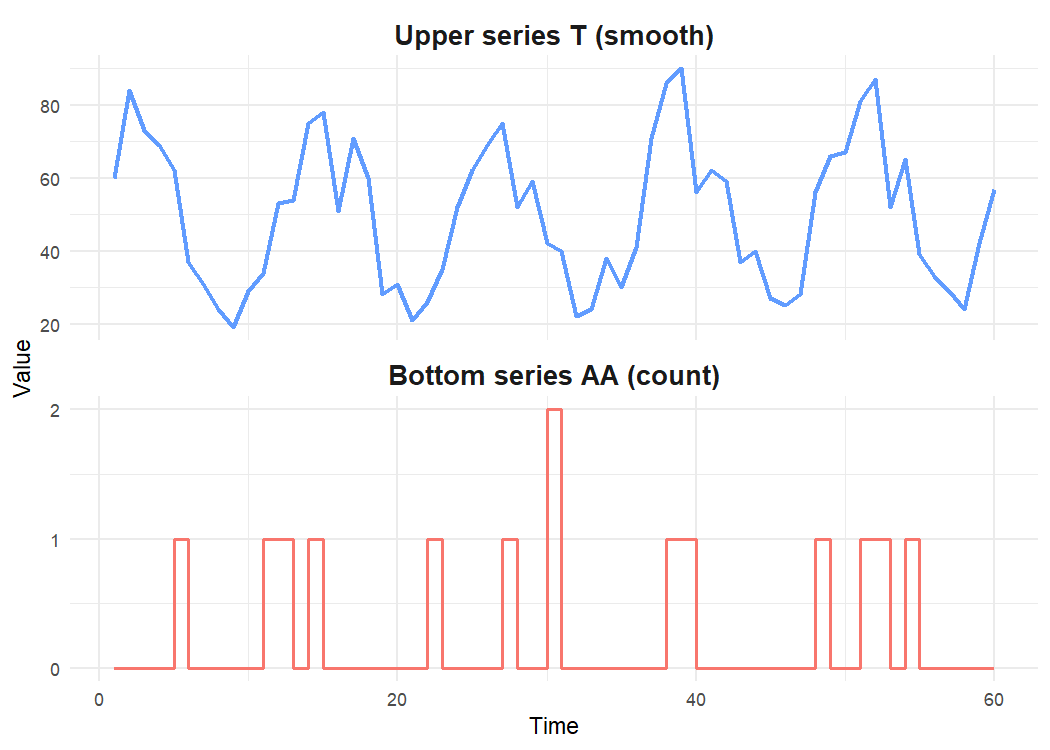
We show a comparison of upper and bottom time series. Even though the bottom series are made of low counts, the upper series can be considered as real-valued due to the smoothing effect of aggregation.
We compute the one-step-ahead base forecasts for each upper series
with an additive ETS model, implemented in the forecast
package. We use the covariance matrix of the in-sample residuals,
estimated via shrinkage using the schaferStrimmer_cov
function, as the joint forecast covariance of the upper series.
mu_u <- numeric(n_u)
residuals_u <- matrix(nrow = n_obs, ncol = n_u)
for (j in seq_len(n_u)) {
  fit <- forecast::ets(ts(U_ts[, j]), additive.only = TRUE)
  mu_u[j] <- as.numeric(forecast::forecast(fit, h = 1)$mean)
  residuals_u[, j] <- fit$residuals
}
# Estimate the covariance matrix via Schafer-Strimmer shrinkage from in-sample residuals
Sigma_u <- bayesRecon::schaferStrimmer_cov(residuals_u)$shrink_cov
# Save upper base forecasts as a list with mean and covariance
base_fc_upper <- list(mean = mu_u, cov = Sigma_u)
We compute the one-step-ahead base forecasts for the bottom
series using the package glarma.
The base forecasts are Poisson distributions.
base_fc_bottom <- list()
for (j in seq_len(n_b)) {
  bj <- B_ts[,j]
  X <- matrix(c(rep(1, length(bj)), seas), ncol = 2)  # matrix of exogenous regressors
  X_new <- matrix(c(1, 1 + .5*sin(2*pi*(n_obs + 1)/12)), ncol = 2)  # regressors for the forecast period
  fit <- glarma(bj, X, type = "Poi")
  # Bottom base forecasts are Poisson distributions, specified by the rate parameter
  fc_lambda <- glarma::forecast(fit, newdata = X_new, n.ahead = 1)$mu
  # Save the parameters of bottom base forecasts in a list of lists, one for each series
  base_fc_bottom[[j]] <- list(lambda = fc_lambda)
}
We reconcile using both reconc_MixCond
(importance-sampling based conditioning) and reconc_TDcond
(top-down conditioning). These functions implement different methods for
reconciling mixed hierarchies, but they share the same input arguments
and output structure.
res_mc <- reconc_MixCond(
  A, base_fc_bottom, base_fc_upper,
  bottom_in_type = "params", distr = "poisson",
  num_samples = 2e4,
  return_type = "pmf"
)

res_td <- reconc_TDcond(
  A, base_fc_bottom, base_fc_upper,
  bottom_in_type = "params", distr = "poisson",
  num_samples = 2e4,
  return_type = "pmf"
)
The joint forecast distribution can be obtained by specifying
return_type = "samples". In this case, since we set
return_type = "pmf", the functions return the reconciled
marginal forecast distributions as probability mass functions (PMFs).
From these PMFs, we can compute any desired summary (e.g. mean,
quantiles, etc.) using the PMF functions.
# Compare the upper means of the base and reconciled forecasts
upper_means <- rbind(
  base    = mu_u,
  MixCond = sapply(res_mc$upper_rec_pmf, PMF_get_mean),
  TDcond  = sapply(res_td$upper_rec_pmf, PMF_get_mean)
)
colnames(upper_means) <- c("T", "A", "B")
print(round(upper_means, 2))
#>             T     A     B
#> base    56.98 19.84 34.31
#> MixCond 59.24 23.55 35.68
#> TDcond  55.99 20.42 35.57

# Compare the 95% upper quantiles of the base and reconciled forecast distributions
upper_q <- rbind(
  base    = sapply(mu_u, function(m) qnorm(0.95, mean = m, sd = sqrt(Sigma_u[1,1]))),
  MixCond = sapply(res_mc$upper_rec_pmf, PMF_get_quantile, p = 0.95),
  TDcond  = sapply(res_td$upper_rec_pmf, PMF_get_quantile, p = 0.95)
)
colnames(upper_q) <- c("T", "A", "B")
print(round(upper_q, 2))
#>             T    A     B
#> base    81.93 44.8 59.26
#> MixCond 71.00 30.0 44.00
#> TDcond  81.00 34.0 51.00
Finally, we compare the base forecast and the two reconciled forecast distributions for the top series T. The base distribution is a Gaussian density (line); the reconciled distributions are discrete PMFs (bars). The black triangle indicates the actual value of T. We refer to Zambon et al. 2024 for a detailed comparison of the two methods for reconciling mixed hierarchies of different sizes.

Carrara, C., Corani, G., Azzimonti, D., Zambon, L. (2025). Modeling the uncertainty on the covariance matrix for probabilistic forecast reconciliation. arXiv preprint arXiv:2506.19554. Available here
Corani, G., Azzimonti, D., Augusto, J.P.S.C., Zaffalon, M. (2021). Probabilistic Reconciliation of Hierarchical Forecast via Bayes’ Rule. ECML PKDD 2020. Lecture Notes in Computer Science, vol 12459. DOI
Corani, G., Azzimonti, D., Rubattu, N. (2024). Probabilistic reconciliation of count time series. International Journal of Forecasting 40 (2), 457-469. DOI
Zambon, L., Azzimonti, D. & Corani, G. (2024). Efficient probabilistic reconciliation of forecasts for real-valued and count time series. Statistics and Computing 34 (1), 21. DOI
Zambon, L., Agosto, A., Giudici, P., Corani, G. (2024). Properties of the reconciled distributions for Gaussian and count forecasts. International Journal of Forecasting 40 (4), 1438-1448. DOI
Zambon, L., Azzimonti, D., Rubattu, N., Corani, G. (2024). Probabilistic reconciliation of mixed-type hierarchical time series. Proceedings of the Fortieth Conference on Uncertainty in Artificial Intelligence, in Proceedings of Machine Learning Research 244:4078-4095. Available here.
 Dario Azzimonti (Maintainer) |
 Lorenzo Zambon |
 Stefano Damato |
 Nicolò Rubattu |
 Giorgio Corani |
If you encounter a clear bug, please file a minimal reproducible example on GitHub.