
grip (Graph dRawing with Intelligent Placement) is an R package for multiscale graph layout. Its primary unweighted and weighted workflows target 2D and 3D, while opt-in weighted-GRIP, metric-MDS, and edge-KK workflows also support higher-dimensional embeddings. The main workflow is:
grip(metric = "hop") for topology-first layouts,grip(metric = "edge_length") when edge lengths define
the graph metric,compare.layouts() and score.layout() for
real-data layout selection,trace.grip() with the same metric choice for
diagnostics.The package also includes advanced public experimental geodesic-KK utilities for weighted-layout scoring and polish. It builds on the GRIP method described in Gajer & Kobourov (2002) and Gajer, Goodrich & Kobourov (2004).
# Install from GitHub
install.packages("remotes")
remotes::install_github("pgajer/grip")library(grip)
# Lay out a small mesh in 2D using the "mesh" preset
edges <- edges.mesh(8, 8)
coords <- grip(edges, n = 64, dim = 2, preset = "mesh", seed = 1)
plot.layout(coords, edges, pch = 16, cex = 0.6, main = "8x8 mesh")grip() interface for hop-metric and
edge-length-metric layouts.weighted.grip.nd(), with higher-dimensional metric-MDS and
edge-KK workflows available through metric.mds() and
edge.kk().compare.layouts(),
score.layout()).trace.grip().prepare.geodesic.kk(),
score.geodesic.kk(),
prepare.landmark.geodesic.kk(),
score.landmark.geodesic.kk()).plot.layout(projection = "ortho"),
project.3d()).| Family | Preset | Tuned on |
|---|---|---|
| Rectangular grid or lattice | preset = "mesh" |
8x8 and 12x12
meshes |
| Sierpinski carpet | preset = "carpet" |
Level 3 and 4 carpets |
| Tree-like graph | preset = "tree" |
Binary trees, depths 5 and 6 |
| 3D torus or cylinder | preset = "torus" |
Torus sizes 8x8 through
20x20 |
Presets set sensible defaults for the GRIP parameters. Any explicit argument you pass overrides the preset value.
grip(metric = "hop"), the default, when
topology should define the multiscale hierarchy and graph
neighborhoods.grip(metric = "edge_length") when positive edge
lengths should also define shortest-path distances, hierarchy
construction, neighborhoods, and insertion anchors.compare.layouts() and score.layout()
when the graph is important enough to justify a candidate shortlist
rather than a single run.trace.grip() with the corresponding
metric when you need to diagnose how a solve evolved.The historical argument names edge_weights and
weight_list represent positive edge
lengths, not connection strengths. With
metric = "hop", supplied lengths set adjacent-edge force
targets while standard GRIP hierarchy and neighborhood searches still
count hops. With metric = "edge_length", the lengths also
define weighted shortest paths throughout the multiscale engine and are
median-normalized by default. See ?grip for the complete
semantics and normalization options.
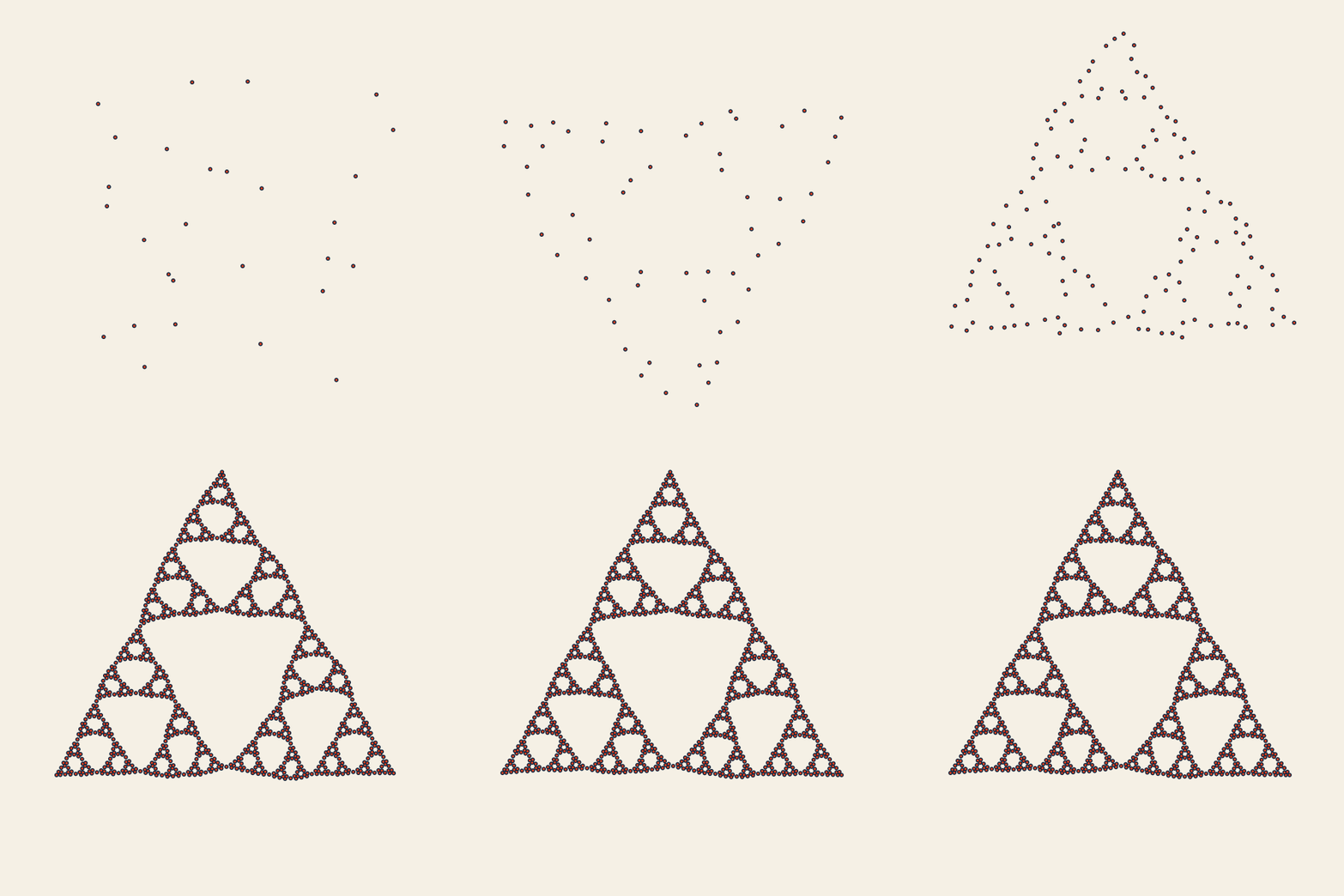
The animations below show the multiscale refinement process captured
by trace.grip(). Starting from a coarse global placement,
the algorithm iteratively refines vertex positions until the layout
converges.
Edge-list input (2D, circle placement)
edges <- edges.cycle(18)
coords <- grip(edges, n = 18, dim = 2, placement = "circle", seed = 2)
plot.layout(coords, edges, pch = 16, cex = 0.7)
Edge-length-metric adjacency list (geometry-aware)
adj_list <- list(c(2), c(1, 3), c(2, 4), c(3))
weight_list <- list(c(1.0), c(1.0, 2.0), c(2.0, 1.5), c(1.5))
coords <- grip(
  adj_list = adj_list, weight_list = weight_list,
  metric = "edge_length", n = 4, dim = 2, seed = 12
)
plot.layout(coords)
3D layout with static projection
edges <- edges.torus(8, 12)
coords <- grip(edges, n = max(edges), dim = 3, preset = "torus", seed = 3)
plot.layout(coords, edges, projection = "ortho", main = "Torus (8x12)")For real-world graphs without a known target layout,
compare.layouts() compares candidates across seeds and
reports quality metrics. Use params.from.summary() to
extract the winning parameters for reuse.
edges <- edges.mesh(10, 10)
cmp <- compare.layouts(edges, n = 100, dim = 2,
                            candidates = c("default", "mesh"),
                            seeds = 1:3)
cmp$summary[, c("candidate", "score.composite", "sampled.stress.mean")]The package ships with four core vignettes:
The pkgdown site also includes companion articles such as the interactive explorer guide, the HMP/U01 object-structure note, the comparison article, and the synthetic-family gallery.
The geodesic-KK helpers are public and documented in the reference index, but they are intentionally positioned as advanced experimental tools layered on top of the main weighted workflow.
If you use grip in published work, please cite the underlying algorithm:
Gajer, P. and Kobourov, S.G. (2002). GRIP: Graph dRawing with Intelligent Placement. Journal of Graph Algorithms and Applications, 6(3), 203–224. doi: 10.7155/jgaa.00052
Gajer, P., Goodrich, M.T. and Kobourov, S.G. (2004). A multi-dimensional approach to force-directed layouts of large graphs. Computational Geometry, 29(1), 3–18. doi: 10.1016/j.comgeo.2004.03.014
GPL (>= 3)