

  ________
 /\ mori  \
/  \       \
\  /  森   /
 \/_______/
Shared Memory for R Objects
→ share() writes an R object into shared memory and
returns a shared version
→ Compact ALTREP serialization — shared objects travel transparently
through serialize() and mirai()
→ Lazy access and automatic cleanup — read on demand; freed by R’s garbage collector
→ OS-level shared memory (POSIX / Win32) — pure C, no external dependencies
install.packages("mori")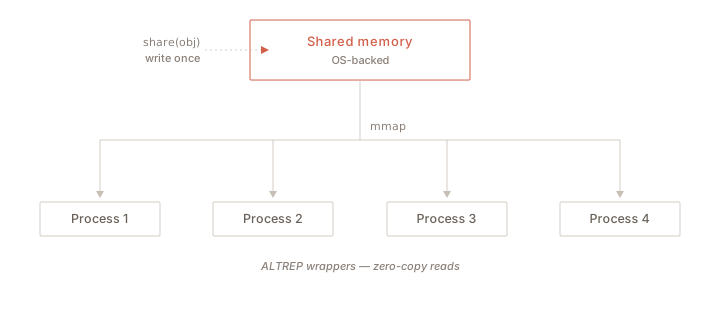
Parallel computing multiplies memory. When 8 workers each need the same 200 MB dataset, that is 1.6 GB of serialization, transfer, and deserialization — with 8 separate copies consuming RAM.
share() writes the data into shared memory once and each
worker maps the same physical pages — turning per-worker copies into
per-worker references.
library(mori)
library(mirai)
library(lobstr)

daemons(8)

# 200 MB data frame — 5 columns × 5M rows
df <- as.data.frame(matrix(rnorm(25e6), ncol = 5))
shared_df <- share(df)
Without mori, each worker holds the full data frame. With mori, each worker holds a small reference into the shared region:
mirai_map(1:8, \(i, data) format(lobstr::obj_size(data)),
          .args = list(data = df))[.flat] |> unique()
#> [1] "200.00 MB"

mirai_map(1:8, \(i, data) format(lobstr::obj_size(data)),
          .args = list(data = shared_df))[.flat] |> unique()
#> [1] "824 B"
Avoiding 8 × 200 MB of serialize / deserialize also translates into a significant runtime saving:
boot_mean <- \(i, data) colMeans(data[sample(nrow(data), replace = TRUE), ])

# Without mori — each daemon deserializes a full copy
mirai_map(1:8, boot_mean, .args = list(data = df))[] |> system.time()
#>    user  system elapsed
#>   0.636  12.832   8.424

# With mori — each daemon maps the same shared memory
mirai_map(1:8, boot_mean, .args = list(data = shared_df))[] |> system.time()
#>    user  system elapsed
#>   0.002   0.003   4.787

daemons(0)Workers must run on the same machine — mori shares physical RAM, not bytes over a network.
shared_name() returns the shared memory name of a shared
object; map_shared() opens a region by that name — useful
for handing a reference between processes without going through
serialization:
x <- share(rnorm(1e6))

shared_name(x)
#> [1] "/mori_d04e_1"

# Another process — here the same one — can map the region by name
y <- map_shared(shared_name(x))
identical(x[], y[])
#> [1] TRUEThe ALTREP serialization hooks emit the same identifier on the wire, so the serialized form is a few bytes regardless of the data size:
length(serialize(x, NULL))
#> [1] 124
This is transparent to any R serialization pathway —
mirai, parallel, callr, and base
R serialize() all carry shared objects as references rather
than copies.
Sub-elements of a shared list serialize as references too — each element travels as a path into the parent shared region, not as the full data:
daemons(3)

# Share a list — all 3 vectors in a single shared region
lst <- share(list(a = rnorm(1e6), b = rnorm(1e6), c = rnorm(1e6)))

# Each element arrives on the worker as a zero-copy reference
mirai_map(lst, \(v) format(lobstr::obj_size(v)))[.flat] |> unique()
#> [1] "904 B"

daemons(0)All atomic vector types and lists / data frames are written directly
into shared memory, with attributes preserved end-to-end. Pairlists are
coerced to lists. share() returns ALTREP wrappers that
point into the shared pages — no deserialization, no per-process memory
allocation.
All other R objects (environments, closures, language objects) are
returned unchanged by share() — no shared memory region is
created.
A data frame lives in a single shared region; columns are read on demand, so a worker that needs 3 of 100 columns only loads 3. Character strings are accessed lazily per element.
df <- share(as.data.frame(matrix(rnorm(1e7), ncol = 100)))
shared_name(df)        # one region for all 100 columns
#> [1] "/mori_d04e_3"
shared_name(df[[50]])  # sub-path into the same region
#> [1] "/mori_d04e_3[50]"Shared memory is managed by R’s garbage collector. The shared memory
region stays alive as long as any shared object backed by it remains
referenced in R — the original returned by share(), or a
column or sub-list extracted from it, in this or another process. When
no references remain — or the session exits cleanly — the shared memory
is freed automatically.
Important: Ensure the return value of
share() is not garbage collected before a consumer can map
its shared memory.
If a process is killed before cleanup can run — a crash,
SIGKILL, or the OOM killer — its region can be left behind.
prune_shared() reclaims such orphans, removing only regions
whose creating process is no longer running.
Shared data is mapped read-only, preventing corruption of the shared region. Mutations are always local — R’s copy-on-write mechanism ensures other processes continue reading the original shared data:
X[1] <- 0) materializes just that vector into a private
copy. Other vectors in the same shared region stay zero-copy.–
Please note that the mori project is released with a Contributor Code of Conduct. By contributing to this project, you agree to abide by its terms.