Clean-room, self-certifying estimation of cross-sectional psychometric network models in base R.
— by Mohammed Saqr
psychnets implements the principal cross-sectional estimators used in psychometric network analysis entirely in base R. The package provides correlation and partial-correlation networks, the EBIC-regularized Gaussian graphical model (graphical lasso), together with its nonparanormal and unregularized stepwise variants, information-filtering networks including the Triangulated Maximally Filtered Graph (TMFG) and Local–Global inverse covariance estimation, relative-importance networks, the Ising model for binary variables, and the mixed graphical model. Whereas these estimators are conventionally accessed through high-level R packages that delegate numerical optimization to compiled Fortran or C/C++ libraries, psychnets reimplements the complete estimation procedures directly in R. In particular, graphical lasso estimation is commonly performed through qgraph and bootnet, which invoke the Fortran implementation provided by glasso, while Ising and mixed graphical models are typically estimated through IsingFit and mgm, both of which rely on the compiled optimization routines of glmnet. psychnets invokes none of these packages or their underlying compiled numerical libraries. Its only package dependencies are the standard R distributions stats, parallel, graphics, and grDevices.
For fitted regularized optimization models, psychnets reports a numerical certificate in the form of the Karush–Kuhn–Tucker (KKT) residual associated with the objective defining the estimator. The KKT residual quantifies the degree to which the necessary first-order optimality conditions are satisfied and therefore provides a direct measure of convergence. Residual values approaching zero indicate that the numerical solution is effectively stationary with respect to the objective function. Because this diagnostic is computed directly from the fitted solution, its evaluation is independent of external optimization software and does not require comparison with reference implementations. Post-estimation transformations and methods without an applicable residual report an unavailable certificate rather than a successful one.
The implementation philosophy of psychnets is based on four complementary design principles. First, the estimation procedure is fully transparent, as both the statistical methodology and the numerical optimization algorithms are implemented explicitly in R, allowing every computational step to be inspected and reproduced without reference to opaque compiled libraries. Second, estimation is reproducible because convergence behaviour is determined by user-accessible numerical criteria rather than by implementation-specific tolerances embedded within precompiled binaries. Third, the package maintains a minimal dependency structure by avoiding external numerical libraries such as glasso, glmnet, qgraph, and Matrix, together with their associated compiled dependency chains, including Rcpp and RcppArmadillo. Finally, estimation is directly auditable because fitted optimization solutions are accompanied by an optimality certificate that quantifies its numerical accuracy with respect to the objective function being minimized. Consequently, the correctness of a fitted optimization can be assessed directly rather than inferred through agreement with an independent software implementation.
Because each optimization problem is solved to numerical stationarity and model selection is performed using the standard formulation of the Extended Bayesian Information Criterion (EBIC), network recovery reflects the theoretical properties of the estimator rather than artefacts of incomplete optimization. As a consequence, edge selection is not influenced by premature termination of the numerical algorithm, thereby avoiding the inclusion of edges that may arise solely from insufficient convergence of the underlying optimization procedure.
Validation uses simulated data with known generating models and
published psychometric datasets. Agreement with reference packages is
assessed using method-appropriate criteria: exact or near-numerical
agreement where objective and solver conventions coincide, and support,
sign, or structural agreement where penalty paths or diagonal
conventions differ. For the EBIC graphical lasso, the comparison limit
is determined by the convergence criterion of the glasso implementation
used by qgraph, approximately (10^{-4}). psychnets solves its native
optimization to tighter tolerances. If post-estimation thresholding
changes a returned graph, certificate() reports
NA for that graph and retains the fitted model’s residual
as $fit_kkt.
# from CRAN (once released)
install.packages("psychnets")

# development version
# install.packages("pak")
pak::pak("mohsaqr/psychnets")psychnets estimates an EBIC-regularized Gaussian
graphical model from data or a correlation matrix and reports its
certificate on printing. The example uses SRL_GPT, one of
the self-regulated-learning datasets shipped with the package (five MSLQ
constructs).
library(psychnets)

net <- ebic_glasso(SRL_GPT)   # EBIC graphical lasso of the five MSLQ constructs
net                           # edges, lambda, gamma, and the KKT residual
#> <psychnet> glasso network
#>   nodes: 5   edges: 10   (undirected)
#>   lambda: 0.00861   gamma: 0.5
#>   optimality (KKT residual): 2.21e-10

net_centralities(net)         # strength and expected influence, tidy
#>   node  strength expected_influence
#> 1  CSU 1.1984512         1.19845117
#> 2   IV 1.0012765         1.00127649
#> 3   SE 0.8492185         0.84921854
#> 4   SR 1.2314317         0.53172852
#> 5   TA 0.6082238        -0.09147935
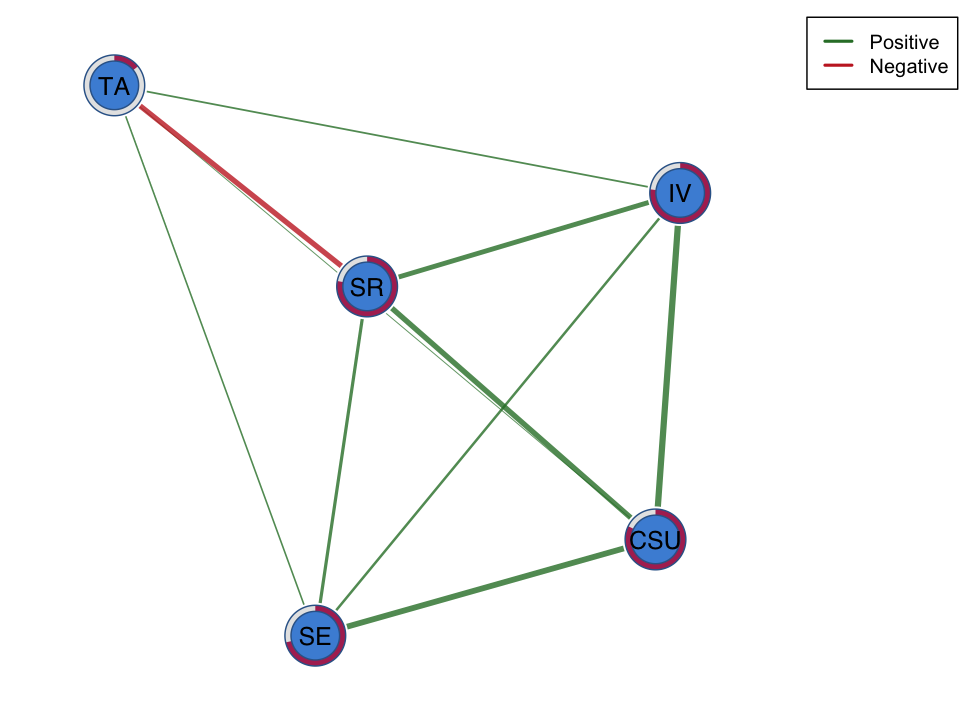
The network is drawn through cograph::splot():
cograph::splot(net, layout = "spring", edge_labels = FALSE, legend = TRUE)
The certificate is available directly, so the distance of the fit from the unique optimum of its objective can be read without an external reference:
glasso_kkt(net$precision, net$cor_matrix, net$lambda)
#> [1] 2.213367e-10The estimators, each fitted in base R and — where regularized — self-certified:
| Verb | Model | Data |
|---|---|---|
cor_network() |
correlation network (with significance thresholding) | continuous |
pcor_network() |
partial-correlation network | continuous |
ebic_glasso() |
EBIC-regularized Gaussian graphical model (graphical lasso) | continuous |
huge_network() |
nonparanormal Gaussian graphical model | continuous |
ggm_modselect() |
unregularized stepwise Gaussian graphical model | continuous |
tmfg_network() |
Triangulated Maximally Filtered Graph | continuous |
logo_network() |
Local–Global sparse inverse covariance | continuous |
relimp_network() |
relative-importance network (LMG / Shapley) | continuous |
ising_fit() |
Ising model, L1-penalized | binary |
ising_sampler() |
Ising model, unregularized | binary |
mgm_fit() |
mixed graphical model | Gaussian + binary; multi-level categorical with
native = FALSE |
psychnet() |
unified front door routing all of the above | — |
The framework verbs operate on any fitted network, and on event logs
and grouped data through psychnet():
| Verb | Purpose |
|---|---|
net_centralities(), net_bridge(),
net_edge_betweenness() |
node, bridge, and edge centrality |
net_clustering(), net_smallworld() |
weighted clustering coefficients and the small-world index |
net_predict() |
node predictability (variance explained; classification accuracy) |
net_boot(), difference_test() |
bootstrapped accuracy and within-network difference tests |
net_stability(),
net_casedrop_reliability(),
net_split_reliability() |
case-dropping stability and split-half reliability |
net_compare() |
the permutation Network Comparison Test |
redundancy(), net_aggregate() |
redundant-node detection and community aggregation |
psychnet() additionally constructs networks directly
from event logs — one row per action — computing action
frequencies and separating within- from between-actor variation, and
estimates a separate network per group on request.
Every fitted network inherits the cograph plotting classes,
and each result object carries a base-graphics
plot() method.
Node centrality plots directly from its result object:
plot(net_centralities(net))
net_boot() resamples the data, re-estimates, and returns
bootstrapped edge-weight confidence intervals; edges whose interval
excludes zero are drawn in the accent colour:
set.seed(1)
plot(net_boot(SRL_GPT, method = "glasso", n_boot = 500), type = "edges")
psychnets treats correctness as a measured quantity
rather than as agreement with a second implementation. For a Gaussian
graphical model, glasso_kkt() returns the stationarity
residual of the graphical-lasso objective; because that objective is
strictly convex its minimizer is unique, so a near-zero residual
certifies the global optimum with no reference solver involved. The
nodewise Ising and mixed graphical models are certified analogously
through the penalized-likelihood score residual. External packages
(qgraph, IsingFit, mgm,
bootnet) serve as cross-checks at independent-solver
precision, never as the definition of correct.
psychnets is checked against the established reference
packages in two ways, both reproducible from a fixed set of package
versions.
Each model is fitted by psychnets and its reference
package on the same data. The table reports the observed comparison
criterion; it is not a claim that every independent implementation
returns numerically identical weights.
psychnets estimator |
Reference package | Data | Observed difference |
|---|---|---|---|
ebic_glasso() |
qgraph::EBICglasso 1.9.8 |
AR(1) chain, n = 1000, p = 8 | edge set identical; max |Δ| = 2.2e-06; KKT = 1.5e-10 |
ising_fit() |
IsingFit::IsingFit 0.4 |
AR(1) latent, n = 2000, p = 6, binarized | edge set identical; max |Δ| = 4.6e-03; threshold r = 1.000 |
mgm_fit() |
mgm::mgm 1.2.15 |
mixed Gaussian + binary, n = 3000, p = 4 | edge set identical; max |Δ| = 1.6e-03; KKT = 1.1e-09 |
cor_auto() |
psych::polychoric / qgraph::cor_auto |
four-level Likert, n = 1000, p = 4 | max |Δ| = 2.0e-05 (psych), 1.7e-07 (qgraph) |
.pbivnorm() (bivariate normal CDF) |
mvtnorm::pmvnorm 1.2 |
five (h, k, ρ) points | max |Δ| = 5.6e-17 |
On real questionnaire and ability data the psychnets
EBIC graphical lasso reproduces the qgraph edge set exactly
— structure agreement equals 1 on every instrument, with a largest
edge-weight difference of 0.008 — and the Ising model matches
IsingFit on binary batteries. The instruments, all loaded
from installed CRAN packages so the comparison downloads nothing:
| Instrument | Source | Items | n | Reference | max |Δ| |
|---|---|---|---|---|---|
qgraph::big5 |
Dolan, Oort, Stoel & Wicherts (2009) | 240 | 500 | qgraph | 3.6e-05 |
psych::bfi |
Revelle, Wilt & Rosenthal (2010) | 25 | 2760 | qgraph | 3e-06 |
psych::sat.act |
Revelle (psych) | 6 | 700 | qgraph | 2e-06 |
psychTools::msq |
Revelle & Anderson (1998) | 50 | 3876 | qgraph | 1.2e-05 |
psychTools::epi.bfi |
Eysenck & Eysenck (1964) | 13 | 231 | qgraph | 8.0e-03 |
psychTools::epi |
Eysenck Personality Inventory | 50 | 3476 | qgraph | 6e-06 |
psychTools::sai |
Spielberger State Anxiety | 22 | 5282 | qgraph | 3.5e-05 |
psychTools::tai |
Spielberger Trait Anxiety | 21 | 3016 | qgraph | 7e-06 |
psychTools::spi |
Condon (2018), SAPA Inventory | 50 | 4000 | qgraph | 1.6e-05 |
psychTools::blot |
Bond’s Logical Operations Test | 35 | 150 | qgraph | 0 |
mgm::Fried2015 |
Fried et al. (2015) | 11 | 515 | qgraph | 8e-06 |
mgm::PTSD_data |
McNally et al. (2015) | 6 | 344 | qgraph | 1.9e-05 |
mgm::B5MS |
Haslbeck & Waldorp (mgm) | 5 | 500 | qgraph | 0 |
mgm::symptom_data |
Haslbeck & Waldorp (mgm) | 48 | 1476 | qgraph | 1.5e-05 |
NetworkToolbox::neoOpen |
Christensen, Cotter & Silvia (2019) | 48 | 802 | qgraph | 4e-06 |
networktools::depression |
Jones (networktools) | 9 | 1000 | qgraph | 6.5e-05 |
networktools::social |
Jones (networktools) | 16 | 350 | qgraph | 7e-06 |
EGAnet::optimism |
Golino & Christensen (EGAnet) | 10 | 272 | qgraph | 6e-06 |
EGAnet::intelligenceBattery |
Golino & Christensen (EGAnet) | 50 | 1152 | qgraph | 2.2e-05 |
psychTools::ability |
Revelle; ICAR ability items | 16 | 1248 | IsingFit | 5.9e-02 |
psychTools::iqitems |
Condon & Revelle; ICAR | 11 | 1523 | IsingFit | 1.2e-02 |
Where the truth is known — data drawn from a known sparse precision
matrix — the psychnets and qgraph estimators
recover the generating structure at the same F-measure. The full
derivation, the worked graphical-lasso case, and the complete tables are
given in the package’s technical report.